Which Artist Is Renowned for His Comicstrip Inspired Art?
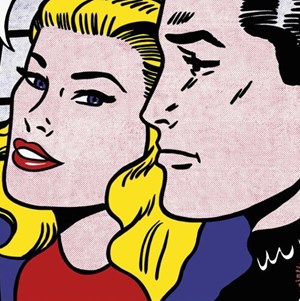
American pop artist Roy Lichtenstein shook up the art earth with his comic-strip inspired paintings and his bold reproductions of cartoon characters. He took images from pop civilisation, and reproduced them in his art to create new contexts and meanings, becoming 1 of the about famous popular artists of all fourth dimension. Lichtenstein as well made sculpture, prints and ceramics, merely is best remembered for his painted works.
Image: Roy Lichtenstein, Masterpiece, 1962, in 2017 the painting sold for $165 million
American pop artist Roy Lichtenstein shook up the art globe with his comic-strip inspired paintings and his bold reproductions of drawing characters. He took images from popular culture, and reproduced them in his art to create new contexts and meanings, condign i of the most famous popular artists of all time. Lichtenstein likewise made sculpture, prints and ceramics, merely is all-time remembered for his painted works.
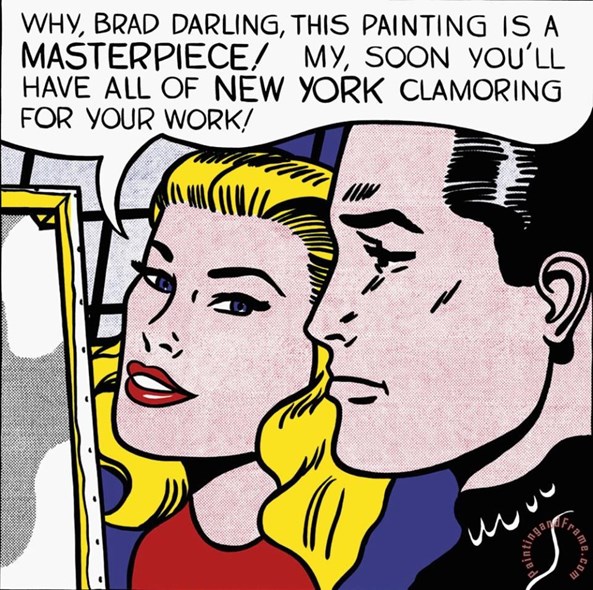
Roy Lichtenstein, Masterpiece, 1962, in 2017 the painting sold for $165 1000000
Born in New York city in 1923, Lichtenstein grew up in a metropolis and an era characterised by prohibition, mass commercialisation, advertising and jazz. The American culture was exploding outwards in all directions and mass consumption was shaping the manner the nation viewed itself.
Lichtenstein had a keen interest in art and music from an early age. To complement his otherwise entirely academic education, he enrolled himself in classes at the New York Schoolhouse of Fine and Applied Art and later at Ohio State University. In 1943, his studies were interrupted and he was inducted into the military, where he served until the stop of the war. During his time in service he visited Paris and London, learning more than almost European art and style.
After the war Lichtenstein returned to Ohio where he finished his caste and took a teaching position, returning to New York in 1957. Once there, he took a position as Assistant Professor at the State Academy of New York. He taught industrial design. Information technology was during this period that Lichtenstein is thought to have kickoff used cartoons and comics every bit inspiration for his work. In 1960 he moved to Douglass College at the State University of New Bailiwick of jersey where he met Allan Kaprow who inspired him to focus on comic books every bit his source textile.
In 1961 Lichtenstein painted Look Mickey,which is widely acknowledged every bit his first pop fine art painting, cementing him as a defining artist of the era and rocketing him to widespread recognition. In 1960 he was taken on by the fine art dealer Leo Castelli. Past 1996, Lichtenstein was chosen as one of 5 artists representing the United states at the Venice Biennale.
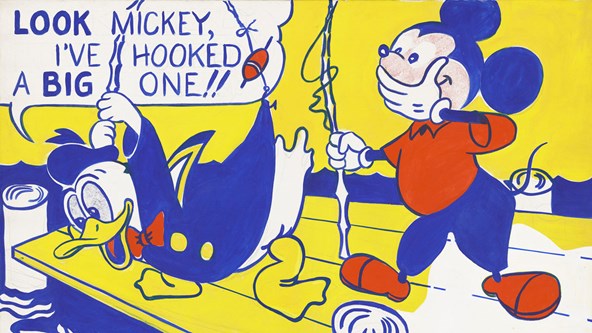
Roy Lichtenstein, Await Mickey, 1961
For Lichtenstein'due south comic paintings, he oftentimes used 4 basic paint colours that reflected the colours available to newspaper and magazine printers. He ofttimes besides used dots to colour his paintings, a organization known as the Ben Solar day dot organisation and used past newspapers to increase the range and result of the colours bachelor to them.
At the tiptop of his career, Lichtenstein produced several works that were drawn from comic strips. Comics had risen to popularity in the 1950s and were rapidly becoming icons of a fast-paced consumer market place and a fairly generic, passive consumer audition. They provided the perfect symbolic reference for Lichtenstein's pop fine art perspective.
Lichtenstein would focus in on a particular paradigm or detail from the comics and recreate it in his work with minor adjustments. His works may appear simple at get-go glance, simply are technically enervating. He used drawing, tracing, painting, varied brushstrokes and line drawings. Unlike the original comic strips, which were apace reproduced and printed, his work is ofttimes painstakingly detailed and advisedly created.
Some of Lichtenstein's critics have accused him of doing footling more than copying the images he works with. He is known to accept defended his work by stating that he makes pocket-size, almost unnoticeable changes to the limerick as well equally to the cropping of the paradigm. Lichtenstein mixed the concept of loftier art – which hangs on gallery walls and is bid for at sale, with the concept of low art which is discarded and often overlooked as being 'true' or 'real' art. By replicating so called 'low fine art' in his loftier fine art style, he challenged the fine art manufacture to ask the question 'what is art and what is worth our time and attention?' Merely several of his contemporaries failed to see the claiming Lichtenstein was making, falling into the trap by dismissing his piece of work as banal or defective in pregnant. In 1964 Life Magazine wrote an article most Lichtenstein in which they asked 'Is he the worst artist ever?'
In 2011 his work I Can Run into the Whole Room and There's Nobody In Itsold at auction for $43.2million. But his work continues to divide opinion.
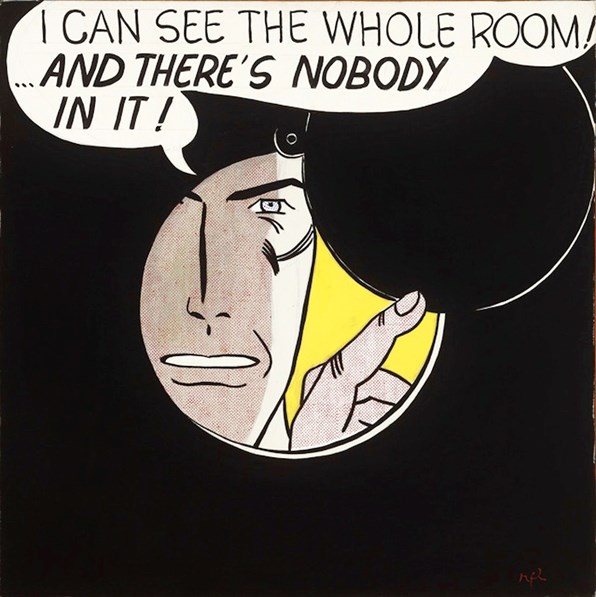
Roy Lichtenstein, I Tin can See the Whole Room and There's Nobody In It
Some people dislike it because information technology appears 'detached' or 'cold' – he does not appear to accuse his paintings with any emotion or personal experience. On the other hand, others dislike it because it is as well attainable – too banal. But within these paradoxes, these criticisms, there seems to be a slap-up and enduring joke existence played. Lichtenstein'south work appears unproblematic, only information technology challenges us in unique, unexpected ways. It defies classification. It is circuitous in its lack of complexity and entirely unique, although it has been wholesale copied from other sources. Nosotros tin can't pin information technology downwards and it defies our expectations.
The comic book imagery that Lichtenstein played with is the embodiment of dismissible, lowbrow fine art. It is mass-produced, created for the pleasure of the audience and for commercial gain. Past borrowing imagery from it and presenting information technology to us on the walls of a gallery, created by the hand of a talented artist, Lichtenstein asked the art earth to reconsider itself, to ask difficult questions and to move out of its comfort zone.
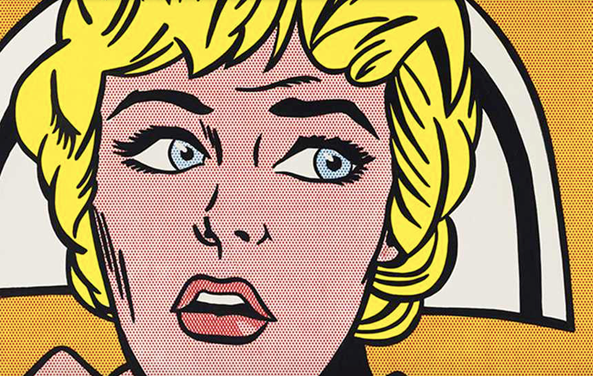
Roy Lichtenstein, Nurse, 1964, in November 2015, this slice was sold for $95.365.000 at Christie'southward New York
In his later career, Lichtenstein moved abroad from comic strip imagery, although he continued to apply the signature Ben Mean solar day dot in nearly of his works. The dots implied reproduction or industrialisation, but as with his comic book works, they set upward our expectations of simplicity and mass product only to shatter them. They were hand produced, painstakingly created, one by one.
Lichtenstein died in 1997 after contracting pneumonia at the historic period of 73.
Kitty Jackson has worked as an arts journalist and writer for more 10 years. She began her career as an Editorial Assistant at WhatsOnStage.com before moving to IdeasTap to become Assistant Editor. After four years Kitty moved towards digital content and began working with leading PR firm PHA Media, helping them to establish a digital department before moving to iProspect, where she was embedded within the digital content team creating content for leading brands including The Body Shop, Thomas Cook and British Gas. Kitty is now excited to render to the world of arts journalism at ArtDependence.
Source: https://www.artdependence.com/articles/roy-lichtenstein-and-the-symbolism-of-the-cartoon/
0 Response to "Which Artist Is Renowned for His Comicstrip Inspired Art?"
Post a Comment