Remedial Reading Programs for Middle School Students
There's a settled body of research on how best to teach early reading. Just when information technology comes to the multitude of curriculum choices that schools take, information technology's ofttimes hard to parse whether well-marketed programs bide past the show.
And making matters more complicated, there's no skillful way to peek into every uncomplicated reading classroom to meet what materials teachers are using.
"It's kind of an understudied consequence," said Mark Seidenberg, a cerebral scientist at the Academy of Wisconsin-Madison and the author of Linguistic communication at the Speed of Sight: How Nosotros Read, Why So Many Can't, and What Tin Be Washed Virtually Information technology. "[These programs] are put out by big publishers that aren't very forthcoming. It'south very difficult for researchers to get a hold of very bones data about how widely they're used."
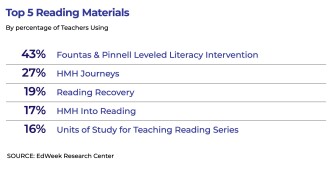
Now, some information are available. In a nationally representative survey, the Education Week Inquiry Eye asked Chiliad-2 and special education teachers what curricula, programs, and textbooks they had used for early reading instruction in their classrooms.
The superlative five include three sets of core instructional materials, meant to be used in whole-class settings: The Units of Study for Teaching Reading, developed past the Teachers Higher Reading and Writing Project, and Journeys and Into Reading, both by Houghton Mifflin Harcourt. At that place are likewise two early on interventions, which target specific skills certain students need more practice on: Fountas & Pinnell's Leveled Literacy Intervention and Reading Recovery.
An Education Week analysis of the materials found many instances in which these programs diverge from evidence-based practices for instruction reading or supporting struggling students.
At this betoken, information technology's widely accepted that reading programs for young kids need to include phonics—and every ane of these 5 programs teaches about audio-letter correspondences. What varies, though, is the nature of this educational activity. In some cases, students principal a progression of letter-audio relationships in a prepare-out sequence. In others, phonics instruction is less systematic, raising the possibility that students might not learn or be assessed on sure skills.
Phonics is "buried" in many commercial reading programs, Seidenberg said. Teachers might be able to employ what's there to construct a coherent sequence, he said, or they might not.
And frequently, these programs are teaching students to approach words in ways that could undermine the phonics education they are receiving.
Several of these interventions and curricula operate under the agreement that students utilise multiple sources of information, or "cues," to solve words. Those tin can include the letters on the page, the context in which the word appears, pictures, or the grammatical construction of the judgement.
Observational studies show that poor readers do utilize dissimilar sources of information to predict what words might say. But studies also propose that skilled readers don't read this way. Neuroscience research has shown that skilled readers procedure all of the letters in words when they read them, and that they read connected text very apace.
Nevertheless, many early reading programs are designed to teach students to make better guesses, under the assumption that it volition make children amend readers. The trouble is that it trains kids to believe that they don't always need to look at all of the letters that make up words in gild to read them.
Nevertheless, teachers may not know that cueing strategies aren't in line with the scientific evidence base effectually educational activity reading, said Heidi Beverine-Curry, the co-founder of The Reading League, an organization that promotes scientific discipline-based reading instruction.
Classroom teachers also aren't normally the people making decisions most what curriculum to use. In Education Week's survey, 65 per centum of teachers said that their district selected their master reading programs and materials, while 27 percent said that the decision was upwardly to their schoolhouse.
Even when teachers want to question their school or district's approach, they may experience pressured to stay silent. Pedagogy Week spoke with 3 teachers from different districts who requested that their names not be used in this story, for fearfulness of repercussions from their school systems.
Cueing Strategies Persist
Reading Recovery, the 1st grade intervention used by about 20 percentage of teachers surveyed, was developed in the 1970s past New Zealand researcher Marie Clay. Xxx-minute lessons are delivered one-on-1, and generally follow a similar structure 24-hour interval to day. The idea is to catch students early on earlier they need more intensive intervention, said Jeff Williams, a Reading Recovery Teacher-Leader in the Solon school commune in Ohio.
Students read books they've read several times before, and and so read a book that they've merely read once, the solar day before, while the teacher takes a "running record." Hither, the teacher marks the words that the pupil reads incorrectly and notes which cue the kid apparently used to produce the wrong word.
For example, if a child reads the discussion "pot" instead of "bucket," a teacher could bespeak that the student was using meaning cues to figure out the word.
During the rest of the lesson, students practice letter-audio relationships, write a short story, and assemble words in a cutting-upwards story. At the cease, they read a new book.
The programme also requires intensive teacher training, which is administered through partner colleges.
Fountas & Pinnell's Leveled Literacy Intervention follows a similar lesson structure, but it's delivered in a small group format rather than one-on-one.
In both programs, text is leveled co-ordinate to perceived difficulty. Teachers are told to match students to books at a just-correct level, with the idea that this will claiming but not overwhelm them.
Students in the lowest levels read predictable text: books in which the sentence structure is similar from page to page, and pictures present literal interpretations of what the text says. One LLI volume, for example, follows a girl as she gets dressed to go sledding in winter. "Wait at my pants," the showtime folio reads, facing an paradigm of the girl holding up a pair of pants. "Look at my jacket," is on the adjacent page, with a photo of the daughter pointing to a jacket.
Irene Fountas and Gay Su Pinnell, the founders of LLI, declined an interview for this story through their publisher, Heinemann. The company also declined to comment.
The main indicate of disagreement concerns these predictable texts and the teaching methods that align to them. For Williams, the Reading Recovery teacher leader in Ohio, anticipated text tin can be a useful orienting tool when children are still learning how print works. The repetitive sentence structure demonstrates that words have consistent significant, and the frequent pictures provide a context to link to the words, he said.
He gave the give-and-take "hippopotamus" as an example. By pointing out that "hippopotamus" starts with the letter of the alphabet "h," and linking that word to a relevant picture and story context, the student can connect the word and the meaning of the word.
"When it'southward in isolation and we only say arbitrarily, 'This shape makes this audio,' that'southward a little abstruse for little kids," Williams said.
But other experts say using anticipated text this way teaches young children the incorrect understanding of how the English linguistic communication works.
"You build this foundation of, English is a language that I accept to memorize," said Tiffany Peltier, a doctoral student at Oklahoma University, who studies reading instruction.
But kids don't memorize words to learn them. Instead, they decode the alphabetic character-audio correspondences. After several exposures, the word becomes recognizable on sight, through a process chosen orthographic mapping.
Of form, a picture of a hippopotamus tin can convey useful information. Information technology could help a kid understand what the fauna looks like, or what it might do in the wild. But a picture show of a hippo won't assist the child read the word.
In predictable texts, students don't accept to recognize the individual sounds in the word, said Peltier, even though learning how to do that is highly correlated with reading ability. And then do Reading Recovery and LLI attend to the sounds in words at all?
Both accept daily sections for letter and give-and-take work. Reading Recovery tests students on 50 phonemes when they enter the program, and teachers target the ones that students don't know, said Williams.
But basing instruction effectually private student errors—rather than progressing through a systematic structure—can get out some gaps, said Kristen Koeller, the educator outreach manager at Decoding Dyslexia California, who used to be a Reading Recovery teacher.
For example, she said, she might accept a student who didn't know the /ow/ sound, like in the words "how" or "wow." Koeller would work with the pupil on that sound, just she wasn't expected to explicate the difference between when "ow" makes the /ow/ sound, like in "how," and when "ow" makes and /o/ sound, similar in "show."
Phonics does happen in Reading Recovery lessons, she said. "But it is not systematic, it is not multisensory, and information technology depends largely on the teacher'south noesis base and the volume that is selected."
LLI does include a telescopic and sequence for phonemic awareness and phonics educational activity. But students enter the program at different points, and information technology'southward possible that they might need more practice with skills that are deemed below their level—or that they will exit the intervention before they accomplish all of the sound-alphabetic character correspondences that they don't know.
The visitor, Fountas & Pinnell Literacy, identifies 2 main studies that it claims validate the program's effectiveness in grades Grand-2. Both are from the Center for Enquiry in Educational Policy at the University of Memphis, and both were funded by Heinemann, which publishes LLI.
The 2010 newspaper, which the visitor calls its "gold standard" written report, found that kindergarten, 1st, and 2nd graders who received LLI made greater gains than students who received no intervention. But these gains were only consistent on Fountas & Pinnell's ain assessment, rather than an external validator of reading achievement. Results on DIBELS, a dissever early literacy test, were mixed. Kindergartners and 1st graders in the handling group did better than the control grouping on some subtests, but 2nd graders saw no deviation.
Reading Recovery, by contrast, has a much stronger evidence base for effectiveness. Most notably, an independent evaluation of the federal grant expanding the programme found that students who received the intervention did meliorate on assessments of overall reading, reading comprehension, and decoding compared to similar students who received their schools' traditional literacy interventions. But even that report has invited controversy.
Psychologists James West. Chapman and William Due east. Tunmer published a critique of the evaluation, arguing that many of the lowest-achieving students were excluded from the programme, potentially inflating success rates.
The executive managing director of the Reading Recovery Council of North America did not respond to requests for comment.
Three core instructional programs also fabricated the top five most popular list among teachers, according to the Education Week survey: The Units of Study for Teaching Reading, past Heinemann, and Journeys and Into Reading, both by Houghton Mifflin Harcourt.
Units of Study for Instruction Reading was developed by Lucy Calkins, a researcher and the founding director of the Teachers College Reading and Writing Project.
The program follows a "reader'due south workshop" model. Teachers requite a curt "mini-lesson" at the beginning of course, and so students spend the bulk of time practicing that skill independently as the teacher monitors them and works with small-scale groups.
"Nosotros remember about what is it that a proficient reader does. What is the life that a good reader leads?" Calkins says in a video describing reading workshop on the Units of Study website. "So higher up all, that means putting reading forepart and center."
Calkins declined an interview for this story through her publisher, Heinemann. The company likewise declined to annotate on the program itself.
Units of Study instills these reading habits in children, and teaches them that reading is something to value, said Susan Chambre, an banana professor of teaching at Marist Higher in Poughkeepsie, North.Y. It also introduces a variety of genres and gives students choice in what they read. "The fact that nosotros are immersing kids in literature—that is important," Chambre said.
Only Chambre struggled with Units of Study when she used it as a kindergarten teacher in an inclusion classroom. The program assumed a lot of cognition—of oral language, of phonics—that students simply didn't take. Chambre would lookout children mumble through sentences, making upwardly words by looking at the pictures.
"For those kids who come up in [to school] and tin can learn foundational skills easily, and accept a fair amount of general knowledge and a fair amount of vocabulary, they would come out okay," Meredith Liben, the senior young man for strategic initiatives at Pupil Achievement Partners, said of the Units of Study for Teaching Reading.
But a lot of students don't come into school with that cognition, and the program isn't explicit enough to fill in the gaps, Chambre said. Starting in kindergarten, students are taught reading "super powers" that encourage them to "search for meaning, use picture clues, and use the audio of the first letter of a word to help them read," according to kindergarten sample lessons downloaded from the Heinemann website. Ane sample lesson encourages teachers to say things like "Bank check the picture," "Try something," or "Does that wait right?" when students struggle, which prompts students to take their optics off of the messages in a word.
In a public statement responding to science-based critiques of her program, Calkins wrote that asking students to guess or "try it" when they come to hard words teaches reading stamina. She also argued that there is value in predictable texts for young children, who are "approximating reading" when they rely on syntax and picture clues.
Though billed as a core reading programme, the Units of Report in Reading doesn't teach phonemic awareness or phonics systematically or explicitly. "At best it's a suggestion, and in that location'southward a lot of focus on the 3-cueing arrangement," Liben said.
The Teachers College Reading and Writing Project recently released a split phonics programme, the Units of Study in Phonics. In her recent statement, Calkins emphasized the importance of a systematic phonics plan, and said it would exist a "wise move" for teachers to include more than decodable texts in lessons with emerging readers. Still, marketing materials for the units imply that the visitor believes phonics should not play a fundamental role in the classroom.
"Phonics pedagogy needs to be lean and efficient," the materials read. "Every infinitesimal yous spend teaching phonics (or preparing phonics materials to use in your lessons) is less time spent teaching other things."
Menu of Choices
The other two core instructional programs, Houghton Mifflin Harcourt's Journeys and Into Reading, differ in some meaning ways from the residual of this list. Into Reading is the company's newer production—this is its first academic year in schools. According to HMH, more than than 6.7 million students use Journeys in schoolhouse.
Both programs include an explicit, systematic program in phonemic awareness and phonics. In an emailed statement to Education Week, a representative for HMH wrote that the visitor suggests teachers follow this sequence, as phonics skills build cumulatively. Decodable texts are available for purchase.
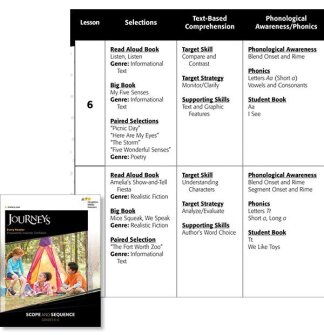
Because these programs are meant to be comprehensive, they include lessons and resources for teaching other foundational skills—similar writing letters, spelling, and fluency—equally well every bit explicit vocabulary instruction, anchor texts and student texts, writing instruction, and comprehension teaching.
Seidenberg, who has reviewed the Journeys materials but not Into Reading, said that the amount of materials, lessons, and instructional choices in the program was overwhelming. "It looks like the publisher's response to all the debate about reading educational activity was to make certain that they included everything," he said.
In the emailed statement, HMH said that teachers can "choose from a diverseness of resources to brand the best instructional decisions for their students and to align with district curriculum requirements."
When Milton Terrace Simple in Ballston Spa, Northward.Y., started using Journeys, teachers were using the materials differently, said Kathleen Chaucer, the principal. (The schoolhouse is no longer using the program.) For case—fifty-fifty though the program offers decodable books, kids were practicing in leveled texts, which didn't offering opportunities to use patterns they learned, Chaucer said.
Journeys includes half dozen teacher manuals for its 1st course program alone, Seidenberg said. "There is so much information in those instructor manuals, it raises serious questions virtually whether anyone is really using them," he said. "And if they are using them, are they just picking through them to observe the pieces that they're comfy with?" Chaucer said that's what happened at her school.
A Perfect Program?
It's difficult to find a perfect curriculum, said Blythe Wood, an instructional coach in the special education department at the Pickerington school district, and the vice president of the International Dyslexia Association of Central Ohio.
She'south critical of Leveled Literacy Intervention, specifically, for the focus information technology puts on looking at words equally wholes, and the lack of decodable text. But at that place are good and bad parts to near commercial materials, she said.
"The cognition base of the teacher, and beingness able to identify the needs of the pupil, are more important than a boxed program," Wood said. "We're not going to meet every child with one box."
Taking a hard look at curriculum is important—but more important is making sure teachers have the training they need to evaluate practices themselves, said Beverine-Curry, of The Reading League. "Only handing teachers materials or a program or a curriculum is not going to practise the task."

This story was produced with support from the Education Writers Clan Reporting Fellowship program.
A version of this article appeared in the December 04, 2019 edition of Education Week as Popular Reading Materials Stray From Cognitive Science
Source: https://www.edweek.org/teaching-learning/the-most-popular-reading-programs-arent-backed-by-science/2019/12
0 Response to "Remedial Reading Programs for Middle School Students"
Post a Comment